
About NGK
Message from the President
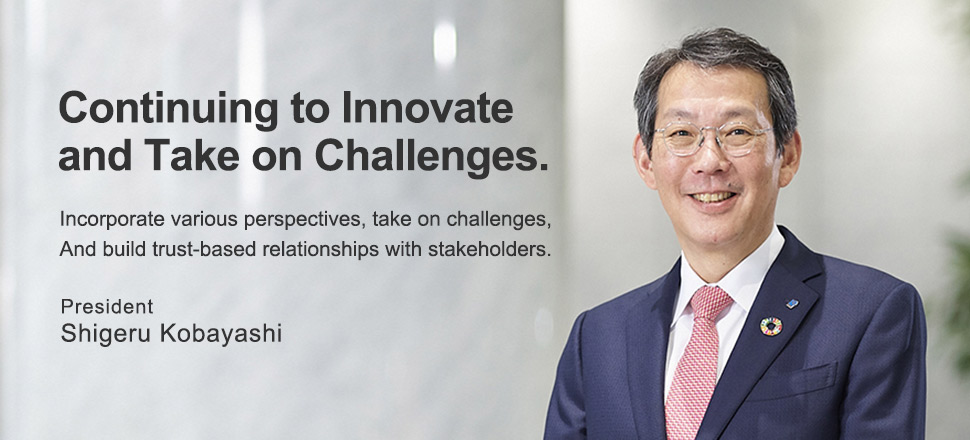
We live in times where volatility is increasing worldwide, and market needs are changing continuously. At NGK, we are embracing the challenge of self-transformation by enhancing the strengths cultivated through our unique ceramic technologies while also converting our business structure. NGK will achieve sustainable growth by identifying growth opportunities in the carbon neutrality (CN) and digital society (DS) domains and providing new value that resolves future social issues.
Looking back on FY2024
During FY2024, we achieved a certain level of numerical success as net sales and profit both outperformed the previous fiscal year. However, in honesty, it is difficult to attribute that performance to internal efforts due to the significant impact of sales being boosted by yen depreciation. In reality, we were handed these results on a silver platter and moving onto the next phase of growth will be impossible if we allow ourselves to become complacent.
In retrospect, FY2024 was a year in which both our strengths and shortcomings became evident. With the package business for communications devices, our projections concerning the contraction of the smartphone, personal computer, and home appliance markets missed the mark in recent years. Added to that was the fact that we were late in responding to such market changes. This resulted in having to record significant operating losses and impairment losses. There is no denying the fact that we were overly optimistic in our market projections and were overconfident in both our own technology and our ability to respond to the market. These are outcomes that we are taking very seriously. This was a painful reminder that the speed of change in the electronics domain is exponentially faster than our traditional fields of expertise, and of just how tough of a competitive environment we face.
The very structure of the world is changing dynamically. With friction between the US and China, geopolitical risks, and the advancing international trend of protectionist policies, our operating environment is more volatile than ever before.
Looking at the automotive industry, the world was forced to recognize the overwhelming cost competitiveness of Chinese battery electric vehicles (BEV) and batteries. In response, Western nations moved to protect their domestic industries by strengthening regulations and tariffs. These actions had the effect of delaying global BEV adoption. The shift towards a renewed appreciation for hybrid electric vehicles (HEV) and plug-in electric vehicles (PHEV) in a positive light is deeply meaningful for NGK as a company that specializes in technology that is based on the internal combustion engine.
From the perspective of economic security as well, various nations are focusing efforts on developing their own domestic semiconductor industries. This trend will certainly serve as a short-term tailwind for our products for semiconductor manufacturing equipment. However, in the long run, the formation of economic blocks and the collapse of free trade schemes is certainly not a preferable outcome for Japan.
With the economic environment changing at breakneck speed, the question becomes: are we truly capable of adapting to such change? Are our strategies and structures keeping pace with market realities? FY2024 was a year in which I asked myself many such questions and, today, I strongly feel the importance of being able to flexibly respond to change and being more aware of our external environment.
Outlook for FY2025 targets amid a volatile external environment
NGK Group Vision outlines FY2025 earnings targets as net sales of 600 billion yen, operating income of 90 billion yen, net income of 60 billion yen, return on equity (ROE) of 10%, a dividend payout ratio of 30%, and profit per share of 200 yen. At present, we are somewhat bearish on our ability to achieve operating income of 90 billion yen but are quite optimistic about all other metrics.
We expect to fall short of our operating income target due to cost increases attributable to inflation and the impact of tariffs as well as insufficient improvement to unprofitable businesses. This conservative outlook on operating income is rooted in the volatility in our external environment. In particular, the direction of US tariff policy can have a direct impact on our business. In the Automotive Ceramics Business, there is a concern that a decline in automotive manufacturer profits due to increased tariffs could increase pressure on businesses throughout the supply chain to lower prices.
There has also been an impact on NAS batteries, for which we are partnering with German comprehensive chemical manufacturer BASF, as it has become difficult to judge the feasibility and timing for moving onto the next stage. While overseas projects do generate a certain level of sales, we also face increasing raw material costs, thus such projects are not helping us secure profits. I believe we will need to carefully assess commercial viability moving forward.
At the same time, there are also some positive signs. In the DS domain, the rapid proliferation of generative AI is driving data volume expansion at an unparalleled pace. This is, in turn, driving significant growth in demand for semiconductor manufacturing machines. Data center-related capital expenditures have been very strong as the semiconductor industry is expected to double in size as we head towards 2030. During FY2025, we are anticipating a solid year-on-year improvement in earnings, and I am highly confident that we are on the right track in terms of our macro direction.
Elevating our PBR
As president, I am keenly aware that our price-book value ratio (PBR) has been below 1x for several years. NGK is advancing a three-way approach to improving our enterprise value. This approach entails enhancing capital profitability, ensuring growth potential, and upgrading non-financial value. At present, however, we have yet to produce satisfactory results. We engaged in company-wide initiatives to enhance capital profitability, which directly correlates to our stock price, with the goal of achieving an ROE of 10% but have been unable to reach this level since FY2022.
One of the reasons for this was our stubbornness with unprofitable businesses that were producing losses or failing to reach internal ROIC standards (Operating income ÷ Business assets). That stance resulted in dragging down overall profit for NGK. One of my biggest regrets is that we did not establish clear deadlines for decision-making concerning whether to rehabilitate or withdraw from such businesses.
I have first-hand experience being involved in the reorganization of overseas business, so I deeply understand the desires of local teams to keep a storied business running and the determination to make a struggling business profitable. However, I have come to understand that, from the perspective of improving profitability for the entire company, sometimes we must make tough decisions.
There is also the reality that past Outside Directors, including the three board members newly appointed in FY2024, have pushed us to make such management decisions. The opinion that we should withdraw from unprofitable businesses is tough, but also frank and rational. This is something that we have come to accept internally. While I am always prepared to make decisions when it is time to withdraw from a business, having such an external perspective has played a major role in helping us increase the quality and speed of our decision-making as a company.
We have also worked steadily on shareholder returns. We have largely been able to maintain a dividend payout ratio of 30%. We are also conducting share buybacks in the range of 10 to 15 billion yen annually, which, when combined with dividends, places us at a total shareholder return ratio exceeding 50%. We will continue working to improve our capital profitability by balancing both growth and shareholder returns.
Business structure conversion that responds to change
Improve enterprise value by engaging in the selection and concentration of existing businesses to enhance earning potential.
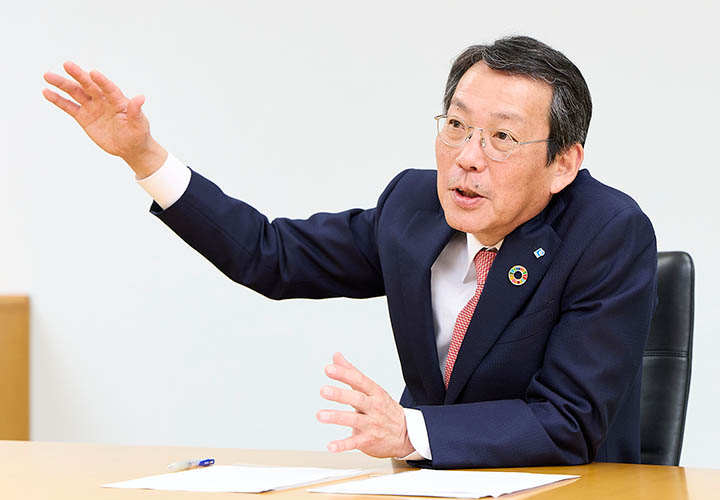
For over 100 years, we have flexibly reorganized our business structure in response to the changing times and changes in society. This is an approach we continue to embrace. We will convert our business portfolio under clear policies outlined from both the short- and medium- to long-term perspectives.
As a short-term perspective, it is critical that we maximize the inherent profitability of existing businesses. The Environment Business (EN) saw major change in its market structure due to the rise of the Chinese BEV. Due to stagnant EV adoption, it appears that the shift to EVs has been pushed back by five years or so. Amid this resurgence of the internal combustion engine, the products we have cultivated over our many years in this field are currently seeing stable demand. While other companies are withdrawing from the market, this is a domain in which we have maintained our strong competitiveness, so we will steadily reap the benefits of being a lasting player in the market. We will then use the EN Business as a profit platform while fostering CN and DS as growth businesses.
At the same time, we have a heightened awareness of the need for selection and concentration for businesses struggling with profitability. We evaluate each business based on two core metrics: the NGK ROIC and sales growth potential. Moving forward, we will establish clear deadlines for businesses with no outlook for improvement with either metric to make policy decisions. For certain business, for example, NAS batteries and ceramic packages for crystals, we will continue to monitor the market environment while carefully considering all the possibilities. We will concentrate our allocation of management resources, including personnel reassignments, in fields with growth potential.
Progress on NV1000 and growth strategy
Create new growth pillars in CN/DS domains to achieve New Value 1000.
As a medium- to long-term perspective, we are working towards New Value 1000 (NV1000), the goal of generating net sales of 100 billion yen or more from new business. In the CN and DS domains, we will create new businesses directly linked to resolving social issues. Including projects in the development phase, we see potential for net sales of around 200 billion yen, so we feel we are advancing steadily towards this goal. In the DS domain, in addition to growth in the semiconductor industry, business related to the ceramic manufacturing equipment and components in which we specialize, is growing at a higher-than-expected pace and drives sales of the jigs and HICERAM Carrier support wafers in which we specialize. Amid an explosive increase in data volume and the spread of generative AI, HICERAM products support high-end semiconductors. The transparency and high rigidity of HICERAM products have been highly evaluated, leading to increased inquiries from customers. We will continue to strengthen our supply capacity to ensure that we capture the growing demand in this field.
In the CN domain, we are focusing on R&D of ceramics for direct air capture (DAC), which directly adsorbs and captures carbon dioxide from the atmosphere, and sub-nano ceramic membranes, which separate specific gases or liquids from mixed gases and liquids at the molecular level. These are essential technologies for a decarbonized society. We expect to see demand growth for these technologies in the early 2030s. Based on the outlook that DS will be the domain of focus through 2030 while CN will take center stage from 2030 onward, we are positioning these technologies as the core of NV1000. There are limitations to what our company can do alone to realize the social adoption of technologies in these domains. This makes collaboration with various partners around the world critical. We consider M&A to be one viable method. We are currently in the process of acquiring BORSIG, a German company with a 188-year history, to acquire functions we lack as well as secure a new customer base. We expect to generate synergy on multiple levels, including combining our ceramic materials with BORSIG's engineering know-how and fusing BORSIG's strengths in organic film with our ceramic technologies. Through business development founded in a co-creation type of M&A, we will deliver products and solutions that provide higher added value to society. The NV1000 goal of 100 billion yen does not include sales from BORSIG. We are positioning this acquisition as a driver of additional growth.
Using market-in concepts to convert technology to value
Our greatest strength lies in our technological capabilities and our insight into ceramics that we have cultivated for over 100 years. We have achieved numerous technological breakthroughs by demonstrating our true worth when faced with difficult requests from customers.
However, as a parts manufacturer, we are in a unique position that sees us with limited opportunities to hear from end users. To continue creating high value moving forward, it is extremely important that we adopt a market-in approach. This means, listening to what the market is saying to identify current needs and the issues customers are facing. To link our technological capabilities to market needs, three years ago we established the Corporate NV Creation. Working in collaboration with Corporate R&D and the Corporate Manufacturing Engineering, we have worked to accelerate the creation and commercialization of new themes.
Our ceramics expertise is built on a vast history of successes and failures. Every experience of trying but failing is passed down through generations in the form of experiment results and technical verification. In recent years, we have used materials informatics (MI) to digitize this accumulated knowledge and create a foundation for future technological innovation. We have high hopes for the use of MI, which we believe has the potential to shorten material development times by up to 90% compared to current standards. Also essential is the promotion of our digital transformation beyond MI. We will proactively adopt the latest technologies, including generative AI, to speed up the search for new applications and improve our operational efficiency.
Regarding the use of intellectual property, we are shifting our stance from defending existing businesses to going on the offensive by creating new businesses. We will promote business, development, and intellectual property strategies based on an integrated approach while also using IP Landscape to strengthen our assessments of technology and market trends.
Human resources with a pioneering spirit are the driving force of the NGK Group
People, technology, intellectual property. Contributing to the resolution of social issues by maximizing our management resources.
Human capital is the driving force of the NGK Group. People conceive ideas, create technology, build equipment, and run operations. It is to these cumulative efforts that we owe the growth we have achieved thus far, and this is something that will remain unchanged moving forward.
However, we also now exist in an era where society and the market are changing so rapidly that conventional approaches no longer work. While the NGK Group has many earnest and sincere employees, our cautious stance of avoiding risks to avoid failure can also be a weakness. One of the values embraced in the NGK Group Philosophy is, “Quality of People, Embrace challenges and teamwork.” As this philosophy suggests, it is important that all employees take on challenges as a personal endeavor and take one step forward in their daily routines. I believe that the driving force for the entire company comes not only from taking on big challenges such as launching new businesses, but also from the small challenges like trying new methods or volunteering for overseas projects.
The Human Resources Department is also strengthening its systems to respond to the challenges undertaken by our team members. One example of this is the creation of a new Key Personnel System. In addition to strengthening our ability to assign the right people to the right jobs, we are providing opportunities for employees who want to hone their expertise and enhance their ability to survive in these rapidly changing times.
Also essential is tapping into the diverse opinions and perspectives of employees both in and outside Japan. While a highly homogeneous organization has a sense of stability, there is a limit to the speed at which it can create new businesses. As a company that has grown on the strength of providing globally consistent quality for products such as insulators and HONEYCERAM, we must proactively work to create an environment in which people with different values and backgrounds can thrive. Advancements in AI are removing language barriers, so we will further work to reflect the voices of our overseas employees in our management and share best practices. We will also actively welcome personnel with diverse experiences and skills, including mid-career hires.
We formulated the NGK Group Human Capital Management Policy to summarize our approach to human capital. We have also exchanged opinions with domestic group companies. We will continue to place importance on dialogue with employees to ensure that this policy permeates the Group and to further strengthen our global human resources strategy.
Existing as a company that is needed and trusted by society
In the spring of 2026, our company will change its name to NGK Corporation. Behind this change is our strong commitment to our current situation and our future. Currently, sales of insulator products account for less than 10% of total net sales as our core business undergoes a major conversion. With approximately 70% of our sales coming from overseas and over 60% of our employees being of foreign nationality, the NGK brand is already widely recognized overseas. As a result, there were growing calls, both internally and externally, for NGK to undergo a name change. This change reflects our commitment to our next stage, which is converting our business structure as outlined in the NGK Group Vision and increasing our value on the global market.
Over the years, we have taken on the challenge of resolving social issues through approaches centered on our unique ceramic technologies. We will never waver in this basic approach, even in times of great change. We will not fear challenges when tackling difficult themes, and we will not stop in our technological development. We will continue to create products that are truly valuable to society. Under our new name, we hope to exist as a company that is needed by society by providing our technologies and products.
As president, my greatest goal is to build the NGK Group of which all stakeholders can be proud and continue to trust. To achieve this, we will continue to innovate and take on new challenges.
Note: This interview was conducted in April 2025.