
Sustainability
NGK Recognized as an “Eco-First Company” by Japan’s Ministry of the Environment
Five Commitments to Contribute to Environmental Conservation
January 21, 2026
NGK INSULATORS, LTD. (hereinafter “NGK”), based in Nagoya, Japan, announced that it has been certified as an “Eco-First Company” under the Eco-First Program promoted by Japan’s Ministry of the Environment. NGK was recognized as an environmental front-runner based on its environmental conservation initiatives and its five commitments toward contributing to a sustainable society.
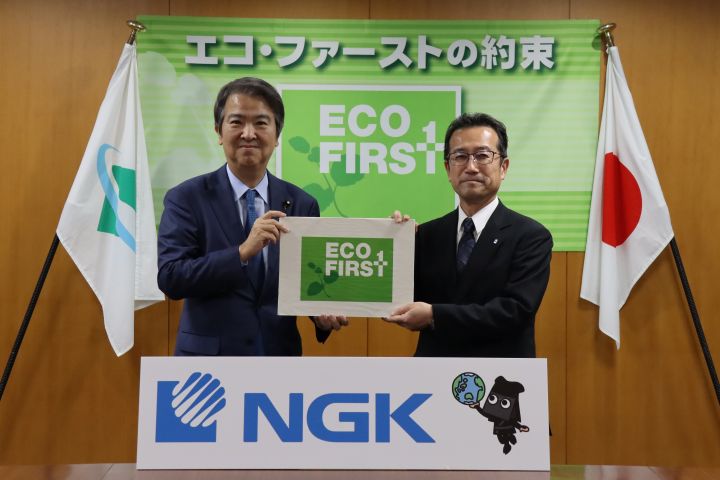
The Eco-First Program is a framework in which companies voluntarily pledge their environmental initiatives to the Minister of the Environment and are certified when those initiatives are recognized as advanced. Certified companies, as “Eco-First Companies,” are expected to further promote industry‑leading environmental activities.
Under the NGK Group Environmental Vision established in April 2021, the NGK Group has set targets to reduce CO₂ emissions (Scope 1 and 2*¹) by 50% from fiscal 2013 levels by fiscal 2030 and to achieve net-zero emissions by 2050. To achieve these goals, NGK has formulated a Carbon Neutral Strategy Roadmap and has been implementing initiatives such as introducing high-efficiency equipment and improving energy operations. In addition, NGK is strengthening initiatives aimed at realizing a sustainable society, including the development of environmentally conscious products and regional collaboration projects utilizing J-Credits. Furthermore, based on the SBT*² certification obtained in 2024, NGK is also pursuing reductions in Scope 3 emissions*³.
Going forward, NGK will continue working toward the realization of a sustainable society through technological development that contributes to carbon neutrality.
NGK’s Five Eco-First Commitments
- Work toward achieving carbon neutrality for Scope 1 and 2 emissions by 2050 and promote reductions in Scope 3 emissions.
- Promote the development and provision of carbon-neutral (CN) related products and services, including ceramic substrates for Direct Air Capture (DAC) technologies that remove CO₂ directly from the atmosphere.
- Maintain a recycling rate of 99% or higher at domestic manufacturing sites.
- Register NGK’s company-owned forest, “NGK Minna no Mori Mizunami,” as a Nature Coexistence Site and participate in the 30by30 initiative*⁴.
- Obtain TNFD Early Adopter recognition*⁵ for early implementation of the TNFD framework for nature-related financial disclosures.
- *1Scope 1 and 2 emissions: Direct and indirect greenhouse gas emissions from the company’s own operations.
- *2SBT: An international certification body for corporate greenhouse gas reduction targets.
- *3Scope 3 emissions: Greenhouse gas emissions generated across the supply chain, excluding a company’s own direct and indirect emissions.
- *430by30: An international goal to conserve and manage more than 30% of national land and sea areas as healthy ecosystems by 2030.
- *5TNFD Early Adopter: Organizations officially recognized by the TNFD (Taskforce on Nature-related Financial Disclosures) for early implementation of the TNFD framework, which guides disclosure of nature-related risks and opportunities.
Reference material
NGK Group Environmental Vision
Ceramics for Direct Air Capture (DAC)